Gold Bars in America: A Short History
For American investors, buying gold bullion bars is a relatively recent development in gold’s 5,000-year story.
Historically, gold circulated as widely recognized coins, not bars. In 1933, U.S. ownership of all gold bullion in any format was prohibited and subject to confiscation under an executive order issued by President Roosevelt. After 40 years of prohibition, the ban was finally lifted in 1974, and U.S. gold bar ownership began to grow rapidly.
Below, we compare standard gold bar sizes to help you shape a practical purchasing plan.
Gold Can Come In Any Shape – But Stick to the Standard
Gold is extraordinarily malleable. It can be hammered into gold leaf thinner than paper or drawn into wire finer than thread. That same malleability makes highly fabricated, precise formats easy to create, from cubes and rounds to rectangles and 3D figures.
In the American bullion bar marketplace, demand favors the familiar rectangular “golden rectangle” profile, characterized by a short-to-long side ratio of approximately 1:1.618. Thickness varies by size: heavier, commercial-quality bars tend to be brick-like, while smaller bars are produced as thin wafer pieces. At the fractional end, the wafer format is more visually appealing in a sleeve, is perceived as a larger piece of gold, and stacks neatly, though it’s too thin for heavy commercial handling.
Why Gold Looks Different: Alloys and Purity
Technically speaking, there is no absolutely “pure” gold, only extremely pure gold. Trace alloys influence color:
- Refiners like Johnson Matthey advanced gold refining in the mid-1800s, removing natural palladium impurities and producing a richer, darker gold tone closer to pure gold.
- Copper used as a hardening alloy adds a red tone (notable in historic U.S. gold coinage).
- Natural gold, found with silver, called electrum, exhibits a distinct bright yellow color.
Purity standards have also increased. In the 20th century, .995 fine was a common bar standard. Today, even commercial kilogram and 100 oz gold bars are widely available in .999 to .9999 fineness. Practically, gold is efficient to refine, so liquidation values track closely to melt across the purity spectrum.
Need Help Investing?
Get your free copy of the Monex Gold Investor Kit
Download Now
How to Compare Gold Bullion Bar Sizes
When comparing gold bullion bar sizes, weigh these buyer-demand factors against your goals:
* When purchased from a reputable dealer and meeting IRS fineness and custody rules, many bars qualify for a Precious Metals IRA.
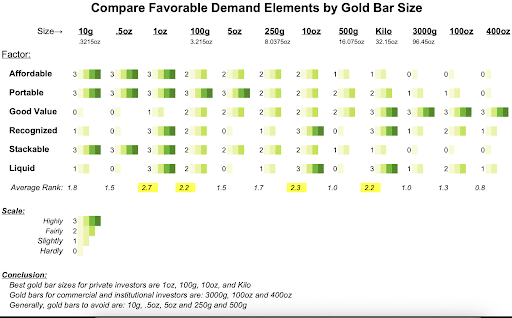
Bottom Line: Choosing Your Gold Bar Size
- Larger portfolios: The kilogram gold bar is a top choice.
- Average portfolios: 10 oz and 100 gram gold bars are the best fit.
- Limited investment portfolios: The 1 oz gold bar is the best alternative for investment.
How to Invest in Gold Bullion Bars
Compare 1 oz, 10 oz, 100 gram, and kilo gold bullion bars, including IRA-eligible options online. For further guidance and purchase assistance, call Monex to speak with a knowledgeable Account Representative.
 Gold
Gold