Gold
Gold  Silver


Potential 2024/2025 US Recession – Impact on Precious Metals Explained
Sean Brazney: Hello, my name is Sean Brazney, Sales Director for Monex Deposit Company. I have the great pleasure of being here today with Jeffrey Christian, Founder and Managing Partner of– Managing Member of CPM Group, one of the many analysts over there at CPM Group. Thank you for being with us again today, Jeffrey.
Jeffrey Christian: : Sean, it’s always a pleasure.
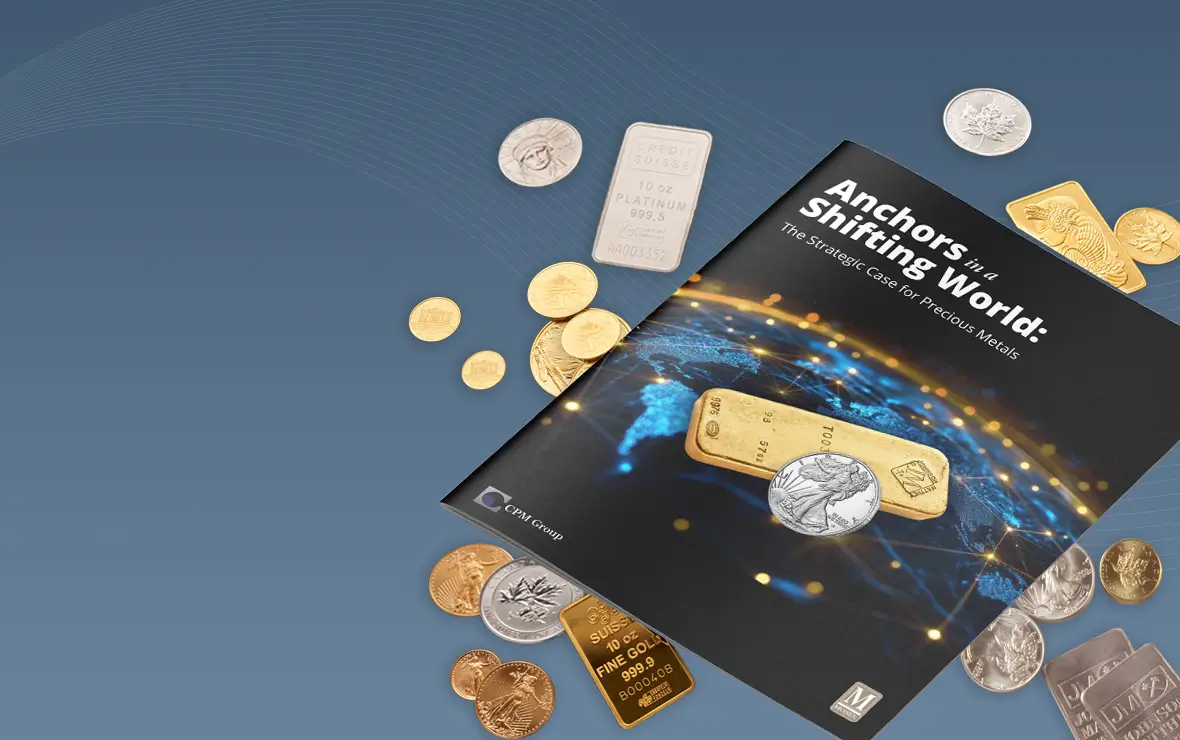
Sean Brazney: Now, of course, you’re the author of our most recent comprehensive report that is out now and available for our viewers, Global Instability and Its Effects on Gold and Silver, and by the way, amazing artwork on that report. I think it should be on the wall behind you next to your Atlas Shrugged poster. It was awesome stuff.
But again, in kind of the later part of that report, about page 11, you brought up a subject that we haven’t really talked about a lot and you expect a potential recession, projecting a potential recession in the second half of 2024, maybe the beginning of 2025, and I’m curious, what do you think the effects on gold and silver will be from that recession if it happens?
Jeffrey Christian: It’s an interesting question, because if you look at past recessions, in the 1970’s, the gold price and silver price rose before the recession, as everybody was looking at this recession coming, they were worried and they bought gold and silver. Then, once the recession started, the price fell off. Then, when the recession was ending, because the Fed was pouring money into the system, as were central banks around the world, the gold price rose again, as did silver. If you go forward in 1991, the gold price didn’t rise going into that recession, but after we got out of the recession, it rose sharply. The same was true in the recession of 2001 and then in the big, great recession in 2007 to 2009, which was followed, it coincided with the global financial crisis, which continued into 2011.
The gold price started rising in 2002. Silver started rising in 2005 in an environment where everything was going wrong in the world or starting to go wrong in the world. We still had strong economic activity until 2007, but people were looking at rising debt levels, not just federal debt levels, but personal and corporate debt levels. They were looking at the Iraq War, the Afghan invasion, the growing tensions between Russia and the United States. There were any number of factors that were there and you saw gold and silver prices rising into that recession, through that recession, and then out of the recession, and that’s sort of what we’re looking at this time around.
We’re looking at an environment where people are concerned, not just about economic activity, recession versus growth, but they’re looking at a whole range of political, financial, economic, and social issues globally and domestically and locally, and they’re saying, “You know, recessions come and go, but these problems are very difficult, and they’re not going to be resolved anytime soon,” and that’s really, I guess, the theme of that report.
Sean Brazney: Are we allowed to have recessions anymore? Is the Fed just going to step in and do what they can to keep that from happening and do they have the juice to do that?
Jeffrey Christian: In the late 1960’s, the Commerce Department had a report called a monthly report full of statistics. We didn’t have the internet, so you got these published reports. It was called the Business Cycle Digest. In the late 1960’s, the Commerce Department changed the name to the Business Conditions Digest, because they were convinced that we didn’t have economic business cycles of recessions and recoveries and expansions and recessions. You know, the Commerce Department said, “No, we’ve solved that. We won’t have recessions in the future.” That was the late 1960’s.
The late 1990’s, we had the new economic paradigm, and we weren’t going to have recessions or inflation anymore and the Dow Jones was going to go to $40,000 within a few months. So, there’s this view sometimes that, you know, I guess there’s a hubris in society that, oh, you know, we’re smarter than we used to be. We have more technology to see these things, and therefore we can manage the economic environment, as well as, the climate, the physical environment—and we’re wrong on both counts.
There will be recessions— 100% chance that there will be future recessions—not just one, but a whole lot of them, and they’ll come cyclically every so often. You know, it used to be every four to six years. Now, it’s every 10 years or so. Overlooking the constructed one in 2020 due to the COVID, we’re due for a recession, and the signs are growing that we’re headed toward one within the next few quarters.
Sean Brazney: Amazing information as always, Jeffrey. We’re very thankful for the report that’s out now. We urge our viewers and listeners to call Monex today. Talk to an account representative and get your free report, Global Instability and Its Effects on Gold and Silver. Thank you again, Jeffrey.
Never Miss Investing News from Monex


Anchors in a Shifting World
Want your kit sooner?
Faster delivery
is available by phone.
800-444-8317